Refractory Engineering Resources for Industrial Furnace Linings
A working reference library for the engineers who specify, install, and maintain monolithic refractory linings — anchor systems, castable dry-out, failure analysis, gunning & shotcrete, and datasheet interpretation. Written from production-side experience inside Zibo's refractory manufacturing cluster, for industrial furnace lining specialists who need engineering judgment, not a price list.
Anchor Engineering for Monolithic Linings
Refractory anchors are the metallic or ceramic components that mechanically retain a monolithic castable or gunning lining against the furnace shell. Anchor type, alloy, height, and spacing are engineered to match lining thickness, hot-face temperature, and thermal-cycling profile — not pulled from a single default pattern. Under-engineered anchorage is one of the most common root causes of premature lining loss, and it shows up independently of castable quality.
The Four Anchor Engineering Decisions
Anchor Alloy Selection by Metal Temperature
Representative continuous-service guidance for anchor metal temperature in oxidizing atmospheres. Final alloy is confirmed against the lining heat-transfer profile and atmosphere — reducing, sulfur-bearing, or chloride environments shift these limits.
| Anchor Material | Typical Max Metal Temp | Typical Application |
|---|---|---|
| Carbon Steel | ~ 400°C | Cold-face / backup layers only |
| 304 Stainless | ~ 870°C | General castable retention, moderate temperature |
| 309 / 310 Stainless | ~ 1000–1100°C | Higher metal temperature, oxidizing service |
| Nickel-Base (e.g. 601) | ~ 1150–1200°C | High metal temperature, thin / high-flux linings |
| Ceramic Anchor | > 1200°C | Hot-face anchoring beyond metal limits |
Values are representative engineering guidance, not maximum-strength ratings. Anchor metal temperature is normally well below furnace temperature because of the insulating lining — the heat-transfer calculation, not the process temperature, sets the alloy.
Castable Dry-Out & First Heat-Up
Dry-out is the controlled first heat-up that removes free water and chemically combined water from a freshly installed castable before the furnace goes to service. It is referenced to practices such as ASTM C865, and it is where a correctly specified lining is most often damaged — by heating too fast. The risk is steam spalling: trapped water vapor builds pressure faster than it can escape, and the hot face can crack or explosively spall.
Representative Staged Dry-Out Schedule
A conservative four-stage profile. The two water-removal holds — free water near 150°C and chemically combined water near 350°C — are the highest-risk windows. Thicker linings and low-cement / ultra-low-cement castables require slower ramps and longer holds.
| Stage | Temperature | Typical Ramp | Hold | Purpose |
|---|---|---|---|---|
| 1 — Free Water | Ambient → 150°C | ≤ 25°C / hr | Hold at 150°C | Drive off physically held water |
| 2 — Bound Water | 150 → 350°C | ≤ 15–25°C / hr | Hold at 350°C | Remove chemically combined water — highest spalling risk |
| 3 — Ramp Up | 350 → 600°C | ≤ 30–50°C / hr | Optional | Develop ceramic bond |
| 4 — To Service | 600°C → operating | Per process | — | Bring lining to working temperature |
Representative only — the final schedule depends on castable grade, section thickness, and the supplier datasheet. Low-cement and ultra-low-cement castables commonly use polypropylene fibers that melt around 165°C to create vent channels and relieve vapor pressure. Always dry out to the grade-specific schedule supplied with your material.
Refractory Failure Analysis
Refractory failure analysis is the structured diagnosis of why a lining wore out, cracked, or dropped before its expected campaign life. Most premature failures trace back to a mismatch between the installed material and the real service environment — not to a manufacturing defect. The five modes below cover the large majority of industrial-furnace lining failures.
Five Common Failure Modes
| Failure Mode | Mechanism | Typical Signature | Common Driver |
|---|---|---|---|
| Thermal Spalling | Thermal-shock stress from rapid temperature swings | Surface cracking, face flaking after trips | Grade with low thermal-shock resistance; fast cycling |
| Chemical / Slag Attack | Slag, alkali, or sulfur penetration altering the bond | Glazing, slag penetration, structural spalling behind a reacted layer | Wrong chemistry for the atmosphere |
| Abrasion / Erosion | Particle or gas-stream wear | Smooth worn channels, localized thinning | Insufficient hardness / CCS for the stream |
| Mechanical / Structural | Anchor failure or expansion-driven overload | Large cracks aligned with anchors, bulging, drop-out | Anchorage under-design; no expansion allowance |
| Installation Defect | Bad water content, segregation, or dry-out violation | Low density, laminations, early explosive spalling | Workmanship and commissioning, not the material |
Iron-oxide chemistry is a frequent contributor to chemical attack in reducing atmospheres — see the Datasheet Library section on Fe₂O₃ limits.
A Simple Root-Cause Framework
Hot Patch vs Cold Repair — Decision Guide
| Factor | Favors Hot Patch (Gunning) | Favors Cold Repair (Recast) |
|---|---|---|
| Damage extent | Localized, surface | Widespread or structural |
| Downtime available | Minimal / online or short stop | Planned turnaround |
| Root cause | Surface wear or erosion | Anchorage or design failure |
| Lining age | Late-campaign bridge to turnaround | Early life / long expected service |
A hot patch buys time; it does not fix a design or anchorage problem. When the root cause is structural, gunning over it only resets the clock on the same failure.
Gunning & Shotcrete Installation
Gunning and shotcrete are spray-applied methods for installing or repairing monolithic refractory. In dry gunning, dry material and water meet at the nozzle; in wet gunning / shotcrete, pre-wetted material is pumped and sprayed. The choice drives rebound loss, dust, density, and the size of job each method suits.
Dry Gunning vs Wet Gunning / Shotcrete
| Parameter | Dry Gunning | Wet Gunning / Shotcrete |
|---|---|---|
| Rebound loss | ~ 15–30% | ~ 5–10% |
| Dust | High | Low |
| Installed density | Lower, more variable | Higher, more consistent |
| Best suited to | Thin repairs, hot patching, complex access | Larger new linings, controlled-quality work |
| Equipment | Rotor / double-chamber gun | Pump + nozzle dosing |
Rebound is wasted material and lost density. The biggest levers are nozzle angle (aim roughly perpendicular to the surface), standoff distance (around one metre), correct water control, and a steady material feed handled by an experienced nozzleman.
How to Read a Refractory Datasheet
A refractory datasheet is a short list of measured properties that tells you whether a castable will survive your service conditions. Reading it well means knowing which numbers matter for your application, and how Chinese (GB/T) and ASTM test methods line up so you can compare like with like.
Key Properties & What They Tell You
| Property | What It Tells You | Why It Matters |
|---|---|---|
| Al₂O₃ content | Alumina level | Higher generally means higher refractoriness |
| Fe₂O₃ content | Iron-oxide impurity | Lower is better — iron oxide is a flux (see note) |
| Bulk density | Mass per volume | Higher density ≈ lower porosity, more strength |
| CCS | Cold crushing strength | Resistance to abrasion and mechanical load |
| PLC | Permanent linear change on reheat | Dimensional stability at temperature |
| Max service temp | Working-temperature ceiling | Must exceed your hot-face temperature |
ASTM ↔ GB/T Test-Method Cross-Reference
Closest-equivalent test standards so a Chinese-tested datasheet and a Western specification can be compared. Methods are not always identical — treat these as a mapping for review, not an exact equality.
| Property | ASTM | GB/T (closest) |
|---|---|---|
| Chemical composition | ASTM C571 / XRF | GB/T 6900 |
| Bulk density & porosity | ASTM C20 | GB/T 2997 |
| Cold crushing strength | ASTM C133 | GB/T 5072 |
| Modulus of rupture | ASTM C133 | GB/T 3001 |
| Permanent linear change | ASTM C113 | GB/T 5988 |
| Castable classification | ASTM C401 | GB/T 23294 |
Why Fe₂O₃ matters: iron oxide acts as a flux that lowers refractoriness and softening temperature. In reducing or carbon-monoxide atmospheres it can promote CO disintegration — carbon deposits catalysed on iron, leading to cracking. High-grade hot-face castables typically target low Fe₂O₃.
Monolithic Refractory Products
Monolithic refractories are unshaped materials installed as a single continuous lining — no mortar joints, faster installation, and precise geometry adaptation. Vuulcan supplies the full monolithic product range, sourced from Zibo's refractory cluster with COA per shipment and engineering review included.
Product Range & Selection Guide
| Type | Installation Method | Typical Application | Service Temp |
|---|---|---|---|
| Dense Castable | Pour / vibrate | Cement kiln outlet, steel ladle, petrochemical furnace | 1350–1750 °C |
| Insulating Castable (LCC/ULCC) | Pour / vibrate | Backup lining, hot-face insulation layer | 900–1300 °C |
| Plastic Refractory | Ram / tamp | Boiler walls, irregular furnace shapes, patch repair | 1200–1650 °C |
| Ramming Mix | Pneumatic rammer / hand | Induction furnace lining, coreless furnace, hearth | 1500–1800 °C |
| Gunning Mix | Wet / semi-dry gunning | Hot repair, blast furnace trough, reheat furnace | 1200–1700 °C |
| Shotcrete Mix | Wet-process spray | Tunnel kiln, large-area lining, rapid cold repair | 1100–1600 °C |
Monolithic vs Shaped Brick: Key Decision Factors
| Factor | Monolithic | Shaped Brick |
|---|---|---|
| Joint integrity | No joints — one continuous mass | Mortar joints = potential weak points |
| Complex geometry | Adapts to any shape | Requires special-shaped bricks |
| Installation speed | Faster — especially gunning & shotcrete | Slower — brick-by-brick |
| Hot repair | Gunning mix: possible during operation | Requires shutdown |
| Thermal shock resistance | Dependent on formulation | Generally higher (certain grades) |
| Typical lifetime | Application-dependent | Application-dependent |
The Engineering Behind
the Resources.
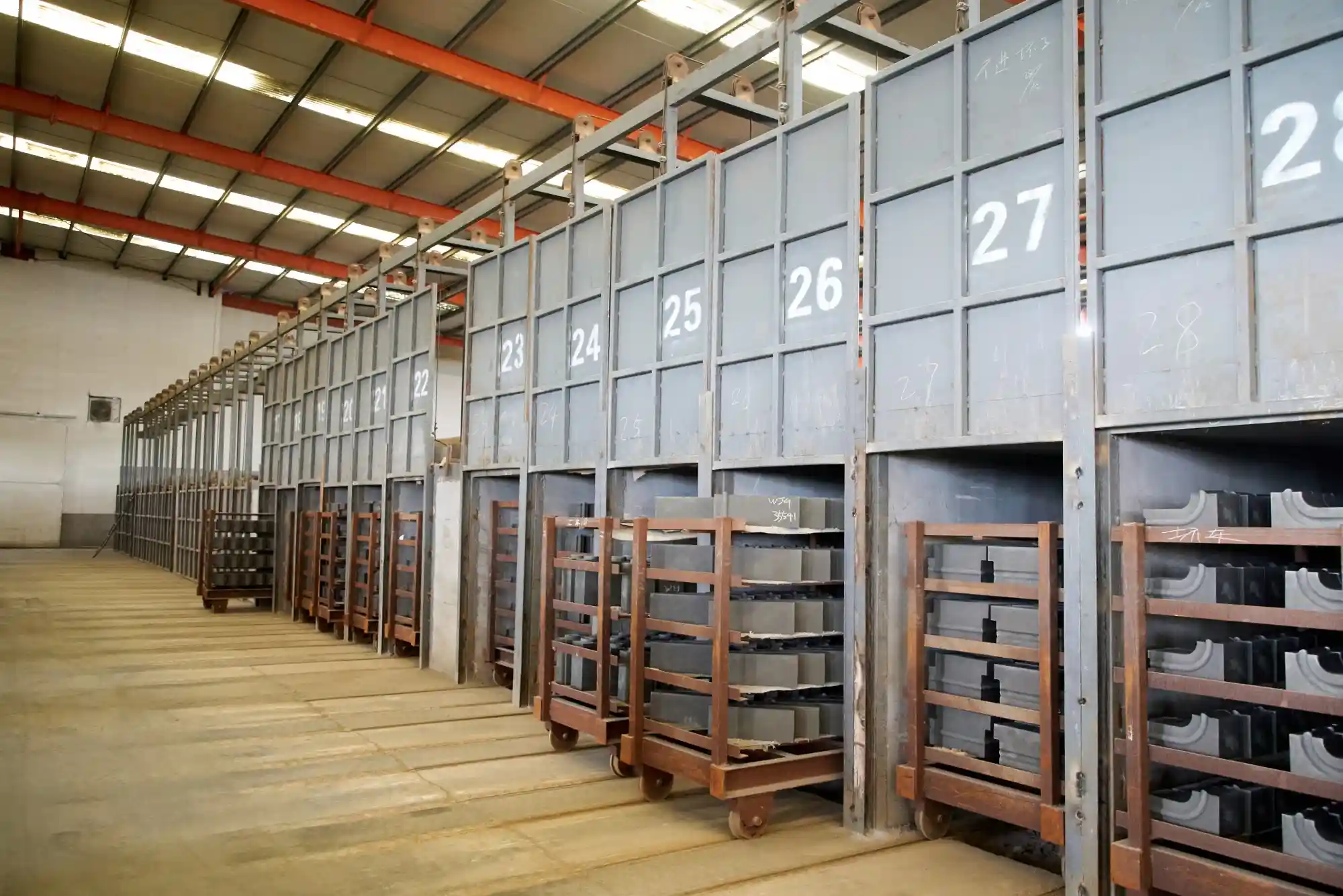
Vuulcan Refractories was founded by a team that grew up inside Zibo's refractory manufacturing industry. We did not enter refractories from the market side — we entered the market from inside the industry. Our experience began on production lines, beside furnaces, raw material systems, and quality control laboratories. Over 20 years of manufacturing experience shaped how we evaluate materials, select production partners, and engineer refractory systems for demanding thermal environments.
The raw material science behind quality refractory brick — particle size distribution, binder chemistry, sintering behaviour — is also the foundation of monolithic castable engineering. As Zibo's refractory cluster evolved from brick-only production into castable systems, it carried decades of firing knowledge into a new product form. The resources on this page are grounded in that same production-side understanding — engineering judgment built from making, not from sourcing.
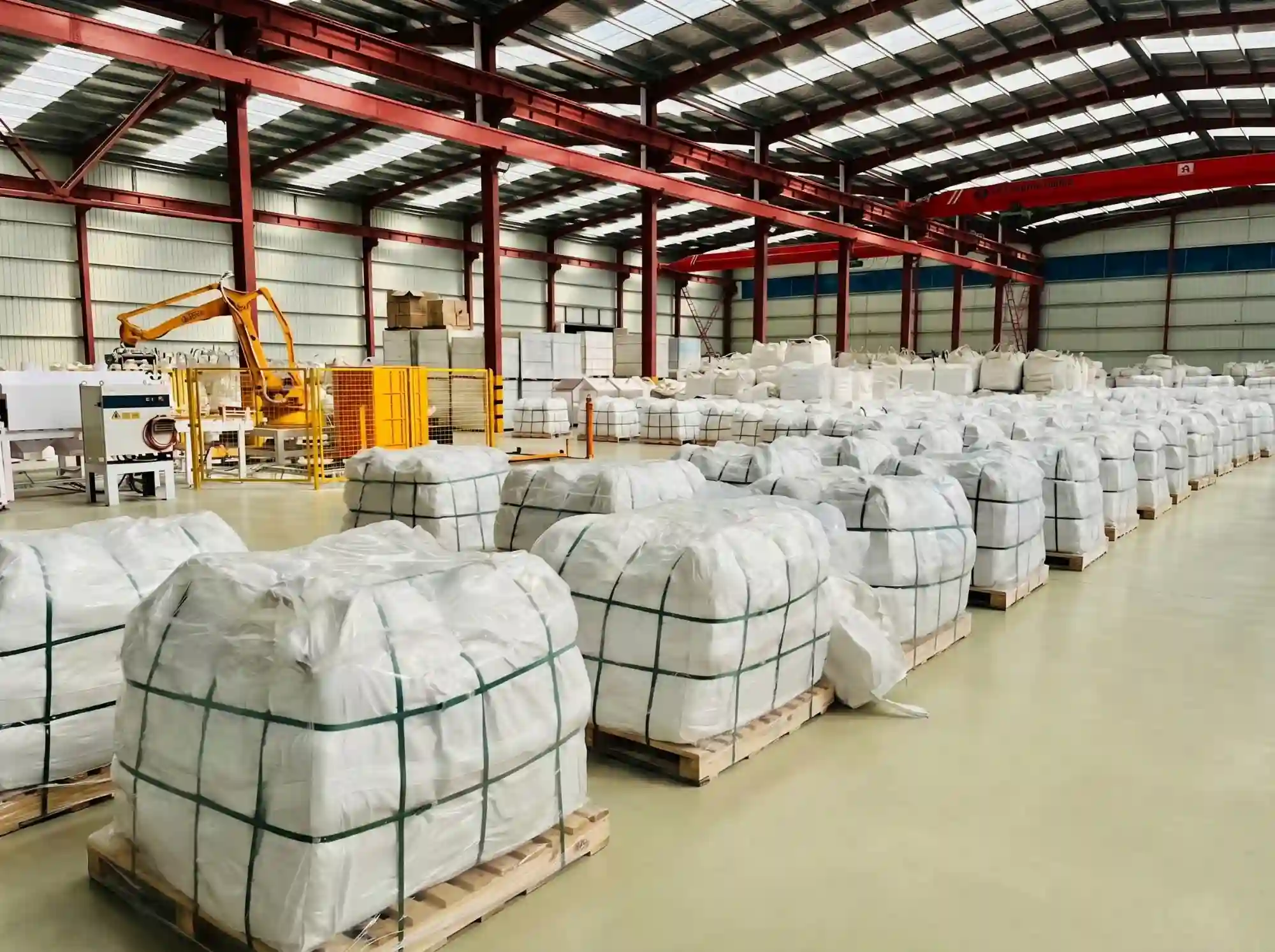
Today, Vuulcan operates as a cluster-backed brand — matching each application to the right production partner within Zibo's qualified manufacturing network. Vuulcan owns the engineering interface and quality oversight. The cluster provides the manufacturing depth.


Certifications Held by Our Zibo Production Partners
We coordinate supply from audited production partners in the Zibo refractory cluster. The facilities we source from hold the certifications below, and batch-level chemistry reports follow every shipment — so your QA team has documented traceability before containers land.
From Resources to a Zone-Engineered Lining System
These engineering principles turn into specified lining packages. If you run cement kilns, steelmaking furnaces, or petrochemical furnaces, we engineer the castable lining for each — zone-mapped grades, anchorage, and backup insulation coordinated in one proposal.
Cement Kiln Castable
Zone-mapped castable for cement rotary kilns — feed end, calcining, transition, burning, and cooler zones. LCC and ULCC grades, full COA per shipment.
View Cement Kiln LiningSteel Furnace Lining
High-alumina and magnesia castable for EAF furnace wall, steel ladle, tundish, and taphole — zone-mapped grades with brick and anchorage coordinated in one package.
View Steel Furnace LiningPetrochemical Furnace Lining
Zone-engineered castable for cracking furnaces, reformers, process heaters, and sulfur recovery units. Anti-coking and sulfur-resistant grades, backup insulation included.
View Petrochem Furnace LiningFrom Question to Delivered Lining System — 4 Steps
Inquiry & Scoping
Tell us your furnace type, service conditions, current lining performance, and the engineering question you are working through. We respond within 6 hours during business days.
Technical Proposal
Within 6 hours: grade and anchorage rationale, dry-out guidance, backup insulation specification where relevant, and FOB pricing. No commitment required.
Sample & Validation
Sample shipment available before full order. COA and application-specific test data included. We recommend physical testing at your facility before committing to a full lining program.
Production & Delivery
Coordinated production across Zibo cluster partners. Standard lead time 18–28 days FOB Qingdao. Export documentation complete on shipment.
Talk to a Refractory Engineer
Share your furnace and the question you are working on. We respond within 6 hours with engineering input and, where relevant, a lining proposal and FOB pricing.